

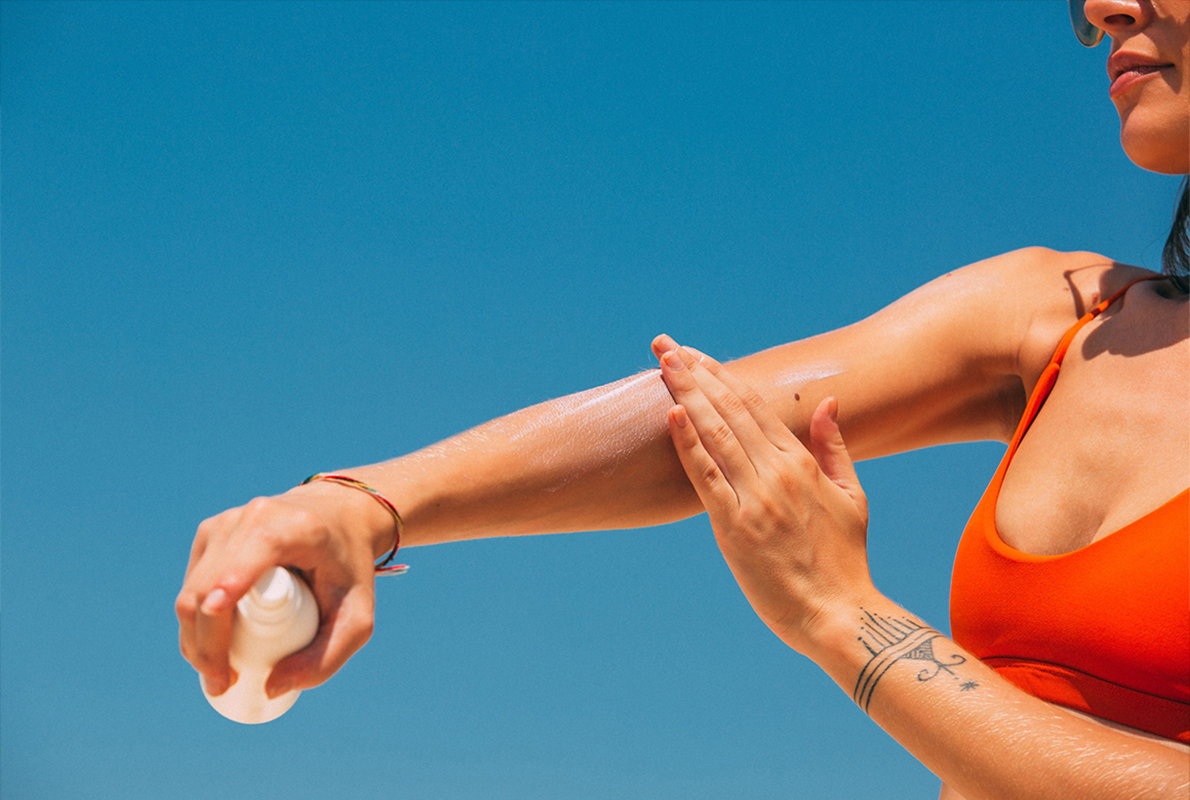

To get real answers, we sat down with Steve Vivier, second-generation owner and President of Vivier Pharma, a Canadian pharmaceutical-grade skincare company, on Episode 4 of our Coffee With Us podcast. We paired his advice with guidance from board-certified dermatologists to build a routine you can actually keep up on the road – one built around fewer, smarter steps instead of a suitcase full of products you’ll abandon by day two, and part of a broader shift we’re seeing toward glowmading: travel planned as much around how you’ll feel as where you’ll go.
Steve Vivier joins Coffee With Us to talk travel and skincare – Listen to the Full Episode →
Two things do most of the damage while you travel: dry cabin air, which pulls moisture out of your skin, and stronger UV exposure at altitude, which most people don’t protect against. The fix isn’t a bigger routine. It’s a smaller, more consistent one built around three steps: cleanse, treat, protect.
Vivier’s biggest piece of advice has nothing to do with products – it’s about cutting down what you’re trying to maintain. A 10-step routine that works at home rarely survives a week of early flights and late check-ins, so he recommends narrowing down to those three non-negotiables: a cleanser, one treatment step (a serum for hydration, brightening, or antioxidants), and sunscreen. Everything else – extra exfoliation, retinol, add-on treatments – can wait until you’re home without undoing your progress.
He also points out something most generic advice misses: the nighttime routine is usually the first casualty of travel, not the morning one. Knowing that about yourself ahead of time helps. If you know you’ll be too tired to do five steps at 11 p.m. in a hotel room, pack a simplified two-step night routine instead of your full one.
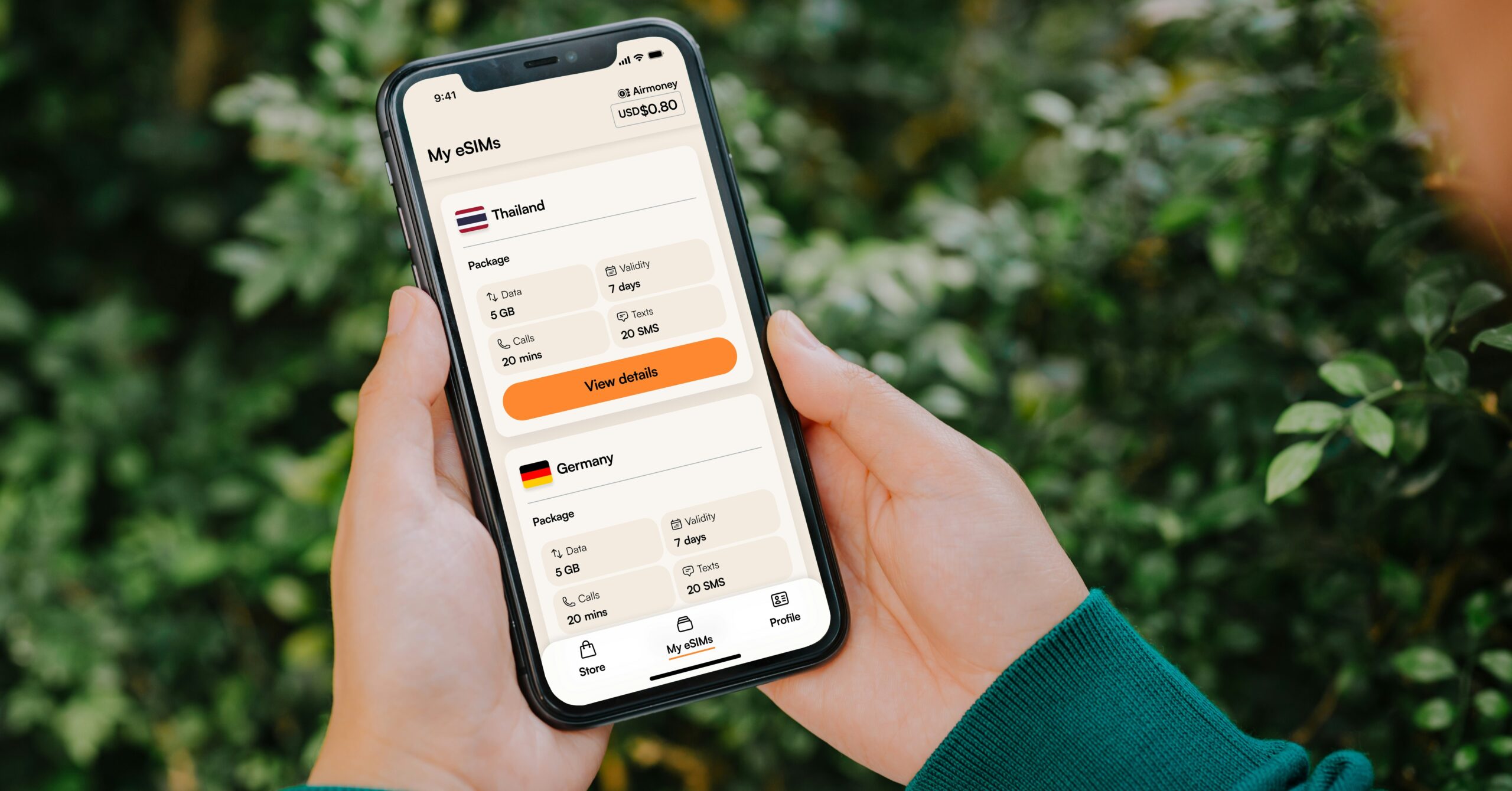
For packing, Canadian travellers are limited to 100 mL containers for liquids and gels in carry-on bags, all packed together in one clear, closed, resealable bag no larger than 1 litre, per CATSA rules. Most travel-sized skincare is formulated under that threshold, though cleansers and toners are sometimes sold in 150 mL bottles as more volume is needed to last two or three months of usage. Vivier’s own workaround: buy empty travel bottles from the pharmacy and decant your regular products rather than buying separate minis for every trip. The same logic applies to other easy-to-forget prep, like sorting out your eSIM before you land instead of scrambling at arrivals.
Aircraft cabins typically sit below 20% humidity, compared to the 40–60% most skin is comfortable in. Your dermis is roughly 70–80% water, and that dry air is constantly trying to pull moisture out of it – a process dermatologists call transepidermal water loss.
Two things help: keeping the water you already have in your skin, and adding more. A heavier moisturizer or a facial mist during the flight covers the second part. For the first, be careful with hyaluronic acid – a board-certified dermatologist interviewed by TODAY notes that hyaluronic acid needs to be applied to damp skin, because on already-dry skin it can pull moisture from the skin instead of adding it. Ceramide-based moisturizers are a safer bet for sealing in hydration on a plane specifically.
If you’re a fan of the in-flight sheet mask trend, one nuance is worth knowing: masks work best in humid environments, and in a dry cabin they can start losing moisture back into the air around them the longer they sit on your face. If you use one, follow it immediately with a moisturizer to lock in what it added rather than leaving your skin exposed afterward.
Skip the wine and the coffee if you can. Dehydrating drinks and salty snacks pull moisture from your body generally, which shows up on your skin too.
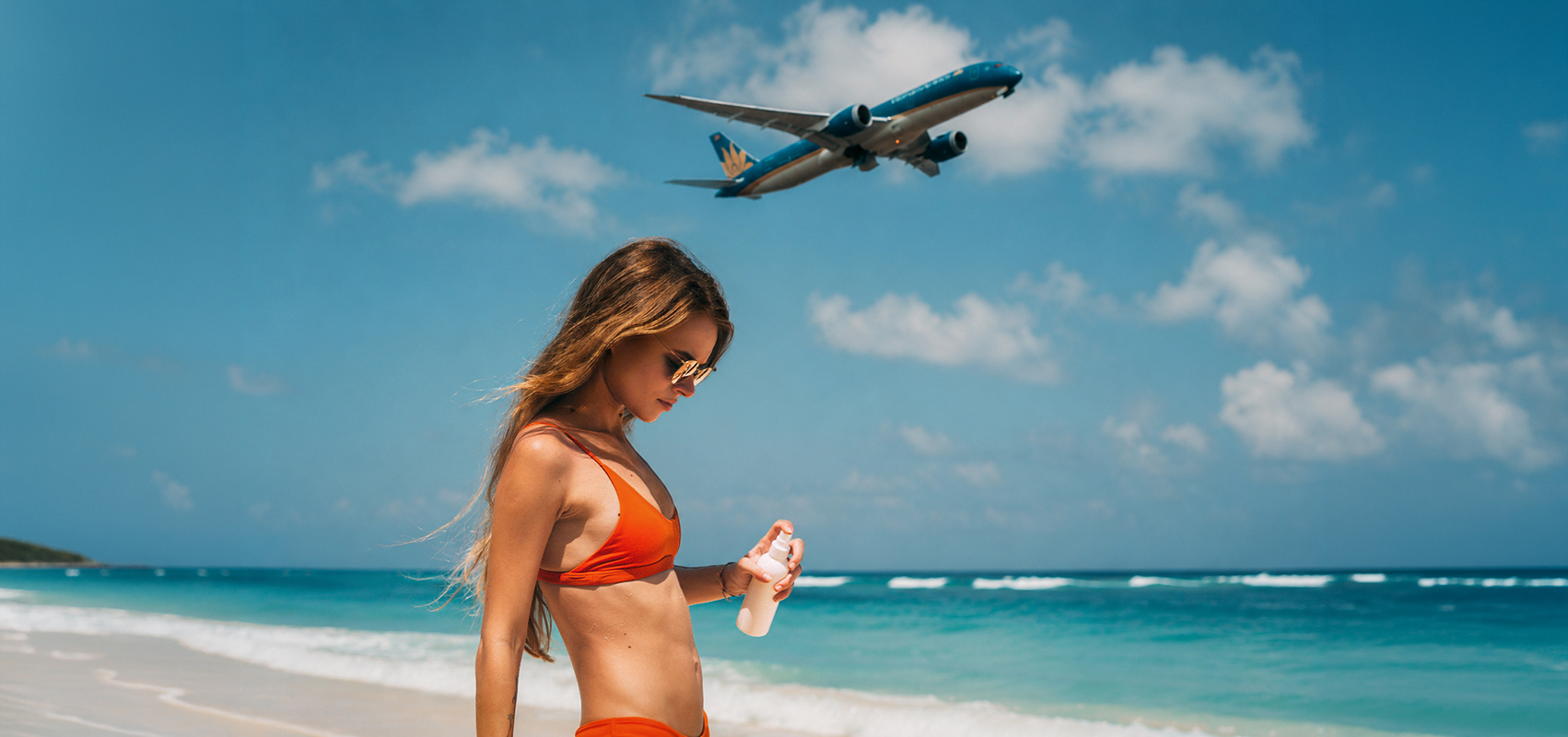
This is where most people’s routines fall apart completely, and it’s Vivier’s top piece of advice: sunscreen compliance, on the ground or in the air. If you’re in a window seat during a daytime flight, you’re getting real UV exposure – the same way your arm gets warm through a car window on a road trip. Some dermatologists go a step further and suggest choosing an aisle seat specifically to reduce that exposure on long daytime flights.
On the SPF question: going from SPF 30 to SPF 50 does not double your protection. SPF 15 blocks about 93% of UVB rays, SPF 30 blocks about 97%, and SPF 50 blocks about 98% – as the SPF number increases, the difference in protection becomes smaller, and no sunscreen blocks 100% of UV rays. There’s also a distinction worth knowing: SPF only measures UVB protection, not UVA, which is why dermatologists recommend looking for a “broad spectrum” label if aging is your concern, not just burning. Application matters as much as the number on the bottle – reapply every two hours if the sun is hitting you directly, and be generous, especially with sprays.
A genuinely useful packing trick from Vivier: tinted sunscreen. It protects, blends into various skin tones using, evens out your complexion, and can double as a light foundation or primer, cutting down what you need to pack – and it’s not gendered, despite the marketing. Vivier Pharma’s own lineup includes Sheer SPF30 Mineral Tinted with their ChromaTint™ technology and non-tinted SPF 30 options and an SPF 45.
One more thing worth checking before you pack: several popular destinations now restrict sunscreen ingredients to protect coral reefs. Hawaii and the U.S. Virgin Islands ban the sale of sunscreens containing oxybenzone and octinoxate, and places like Aruba, Bonaire, and Palau, along with cenotes and eco-parks in Mexico, either ban or strongly discourage them too – including some popular snorkeling spots. If you’re headed somewhere with reef protection rules, pack a mineral sunscreen with zinc oxide or titanium dioxide as the active ingredient instead of a chemical one – it won’t be confiscated, but it may not be sold locally.
Give your skin the first 24 hours to recover. Gentle cleansing, a hydrating moisturizer, and holding off on retinol or exfoliating acids until your skin feels normal again helps it bounce back faster from the stress of the flight.
From there, adjust to where you actually are rather than sticking with your travel routine once you’ve landed – the climate reference below breaks down exactly how. If your trip has room for it, a slower reset ritual helps too, whether that’s a hammam in Marrakech or a steam hut in Chiang Mai – both do for the rest of you what a good moisturizer does for your skin. If you’re doing a multi-destination trip, pack a flexible kit rather than switching products completely at every stop, and pay attention to how your skin actually feels rather than following a fixed schedule.
If you manage eczema, rosacea, or another chronic skin condition, keep your usual products in your carry-on rather than checked luggage, and be mindful that heat, spicy food, and alcohol – three things travel serves up constantly – are common flare triggers.

Thailand, the Caribbean, Bali. Go with a lighter gel moisturizer, an oil-control sunscreen, and keep salicylic acid in the rotation if breakouts are a concern.
Desert destinations like Namibia and other high-altitude regions. Reach for a richer moisturizer, an occlusive balm for lips and hands, and mist more often than you think you need to.
Winter mountain trips and northern Europe in the colder months. Use a heavier barrier cream, and don’t skip sunscreen – snow reflects UV back at you.
Regardless of destination. Pack a hydrating serum plus moisturizer, sunscreen if you’re by a window during the day, and skip retinol or exfoliants that day.

Two mistakes that don’t get talked about enough: assuming cloud cover means you can skip sunscreen (up to 80% of UV rays still pass through clouds, so overcast days need it too), and trying a brand-new product for the first time on the trip itself instead of patch testing it at home a few days before you leave.
Beyond that, the basics are still where most routines fail: skipping sunscreen because you’re indoors or by a window, assuming SPF 50 protects dramatically more than SPF 30, and packing a routine so elaborate you abandon it by day two.
You don’t need a bigger skincare routine to survive travel, you need a smarter one. Protect what you’ve already built before you leave, keep it hydrated and shielded from UV in the air, then give it 24 hours to reset once you land and adjust to wherever you are. The travellers who keep their skin in check aren’t the ones packing the most products – they’re the ones who know which few actually matter, planning with a little flexibility built in.
Why does my skin feel drier when I fly?
Cabin air pulls moisture out of your skin faster than usual, but the fix isn’t drinking more water. Dermatologists note that skin surface hydration depends mainly on topical products and your skin barrier, not how much water you drink – so a moisturizer or facial mist during the flight does more for your skin than an extra bottle of water.
Do I actually need sunscreen on a plane?
Yes – and if you have a connecting flight or a long layover with outdoor time, that exposure adds up across the whole day, not just the flight itself. Treat the sunscreen you put on before your first flight as needing a reapplication by your second leg or after a few hours outside, not something that lasts the whole travel day.
Is SPF 50 really better than SPF 30?
Only slightly – but most people don’t apply enough of either to get the protection listed on the bottle in the first place. The lab number assumes a thicker layer than most people use: roughly a nickel-sized amount for the face alone, closer to a shot glass for the whole body. Going up an SPF number matters far less than actually applying that much.
How do I keep my skincare routine simple while travelling?
If you can only manage one thing consistently, make it sunscreen – it’s the step most linked to visible long-term skin damage, and unlike a missed cleanse or serum, there’s no making up for a day of unprotected sun exposure after the fact. Keep a mini version of it in your personal item too, in case a bag gets gate-checked or delayed.
Should I use a hydrating sheet mask on a flight?
If you do, the timing matters more than the product: use it during the first hour or two of the flight rather than right before landing, so you have time to follow it with a moisturizer while the cabin air is still working against you – not deplane with a mask’s residue and nothing sealing it in.

Travel doesn’t have to wreck your skin. It just asks for a smaller, smarter routine than the one you run at home – and, according to Steve Vivier, knowing yourself well enough to know which corners you’ll actually cut before you’re standing in a hotel bathroom at midnight deciding for you. For the full conversation, including more on skincare minimalism and what most travellers get wrong, check out Episode 4 of Coffee With Us.
The line moved slowly. I was standing just outside the airport exit waiting for a taxi. When it was finally my turn, the driver asked for cash. I hesitated, checked my wallet, and ...
I once landed in a new country thinking I would sort out data after arrival. That decision led to standing in an airport late at night, tired, trying to connect to unreliable Wi-Fi...